When you receive a precision component, how much do you know about what happened before it reached final inspection.
Can you verify the material it was manufactured from? Can you connect it to the appropriate material certifications, production lot, manufacturing processes and inspection records? If a question arises months, or even years later, can your manufacturing partner provide the documentation needed to trace the history of that part?
For industries such as aerospace, defense, semiconductor, subsea and energy, these aren’t simply paperwork questions. Traceability is an important part of managing quality and manufacturing risk.
At Pazmac, traceability doesn’t begin when a finished component arrives in the Quality Assurance department. It starts much earlier.
Traceability Starts with the Material
Before you can validate a finished component, you need confidence in the material it was made from. Material traceability helps establish a documented connection between the raw material received and the components ultimately manufactured from it.
Depending on customer and industry requirements, supporting documentation can include Material Test Reports (MTRs) and other records used to verify the material associated with a production order.
Why does that matter?
Because a component can be dimensionally correct and still fail to satisfy the complete requirements of the application if the material itself cannot be properly verified.
For customers working in highly regulated or demanding industries, knowing where the material came from and maintaining that connection throughout production can be just as important as measuring the finished dimensions.
Can You Follow a Part Through Production?
Traceability also means maintaining control as material moves through manufacturing.
Lot control and production records create continuity between incoming material, manufacturing operations, outside processes, inspection and the finished component. Rather than treating each step as an isolated activity, an effective Quality Management System connects them. That becomes particularly important when components require multiple manufacturing and secondary processes.
Pazmac’s capabilities extend beyond CNC machining to include processes and services such as:
- Heat treating
- Gas nitriding
- Grinding
- Electrical Discharge Machining (EDM)
- Coating
- Non-Destructive Testing (NDT)
- Shot peening
- Welding
- Serialization.
Maintaining appropriate records throughout the manufacturing process helps provide visibility into what happened to a component before it reached final inspection.
The objective is not simply to create more documentation. It is to maintain control.
Why Wait Until Final Inspection to Find a Problem?
Quality cannot be inspected into a part at the end of production. Pazmac’s approach is to validate parts throughout the manufacturing process so potential issues can be identified and addressed earlier. This helps reduce the risk of discovering a costly problem only after all of the machining and secondary processing has been completed.
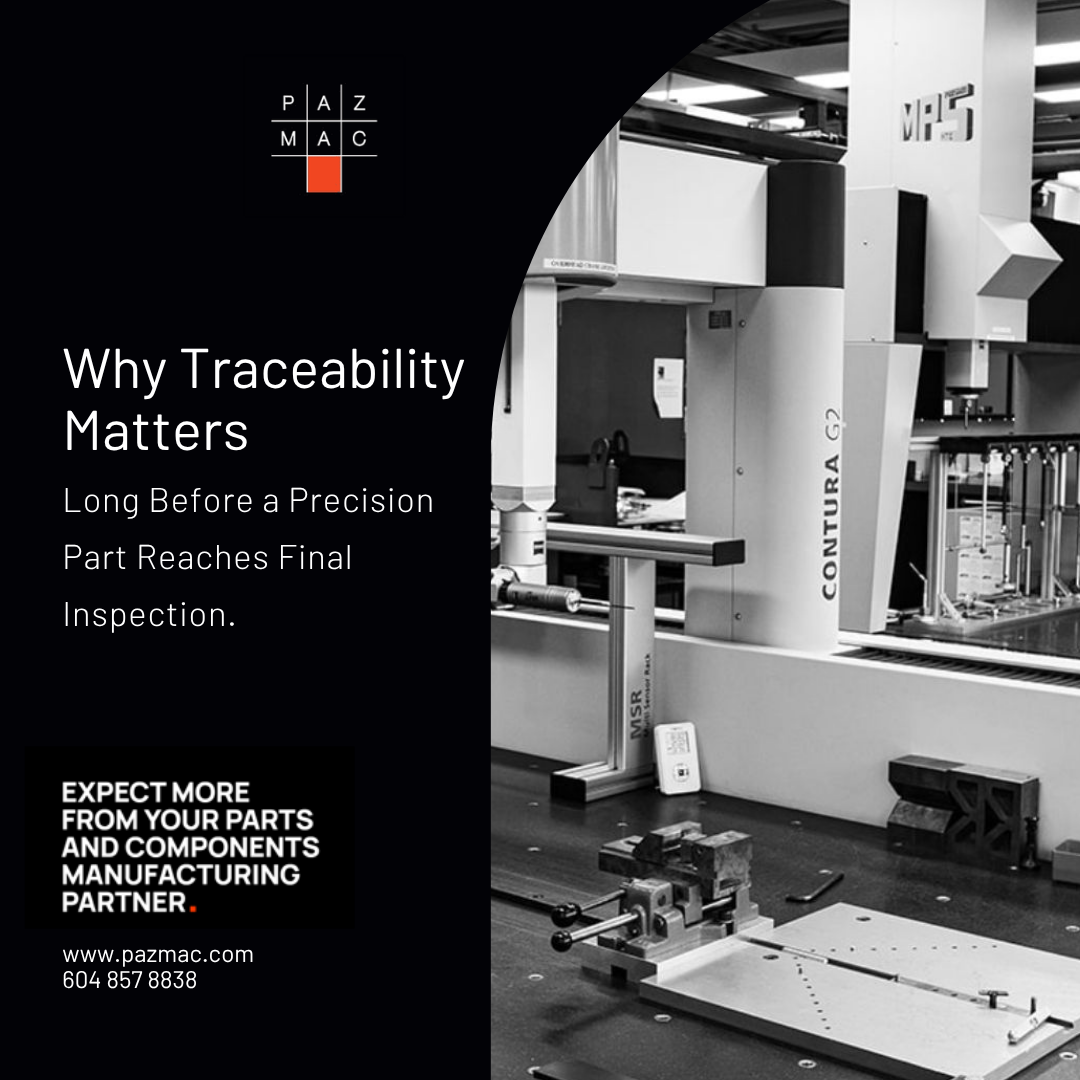
Inspection records create evidence that specified requirements have been checked and verified. Pazmac has invested in extensive metrology and measuring equipment, including four independent Zeiss Coordinate Measuring Machines (CMMs), to accurately measure dimensional requirements including GD&T, tight tolerances and complex features.
These CMMs are located in Pazmac’s temperature- and humidity-controlled Quality Assurance department to provide a stable inspection environment.
This precision equipment is only one part of the equation. The inspection data and records generated throughout production help build the documented history behind the finished component.
What Documentation Will Your Customer Require?
Different customers, parts and industries can have very different documentation requirements.
Pazmac’s internal systems support detailed documentation requirements including:
- First Article Inspection (FAI)
- Inspection and Test Plans (ITPs)
- Production Part Approval Process (PPAP)
- CMM inspection
- Heat treatment and coating inspection
- Non-Destructive Testing (NDT)
- Material Test Reports and inspection reports
- Quality planning including FMEA and SPC, as required.
Understanding these requirements before manufacturing begins is important. It allows the appropriate inspections, records and documentation to be incorporated into the production process rather than trying to reconstruct information after the parts have already been manufactured.
AS9100D Certification Raises the Expectation for Traceability
Pazmac achieved AS9100D certification in March 2026, building on the company’s long-standing ISO 9001:2015 Quality Management System.
For aerospace and defense manufacturers, AS9100D represents a higher level of quality-system discipline. It places increased emphasis on areas including risk management, configuration and change management, supplier oversight, product safety, documentation and traceability.
For customers, that discipline matters because traceability provides more than a historical record. It helps create accountability throughout the manufacturing process.
If a question or non-conformance occurs, strong traceability can help identify the affected material, production activity or inspection record. That information can support a more focused investigation and corrective-action process rather than leaving manufacturers trying to reconstruct what happened after the fact.
Traceability is About Confidence
At Pazmac, we believe a precision parts manufacturer should be able to validate that the parts it produces meet customer specifications. That requires more than a final dimensional check.
It requires disciplined systems that connect material, manufacturing processes, inspection and documentation throughout the production lifecycle. Pazmac’s AS9100D and ISO 9001:2015 certified Quality Management System provides the framework for maintaining that level of control.
When your components are going into demanding applications, you shouldn’t have to wonder how they were manufactured or whether the documentation exists to support them.
Will your parts pass final inspection? What you should be asking is if your manufacturing partner can demonstrate what happened long before they reach inspection.
Expect More.